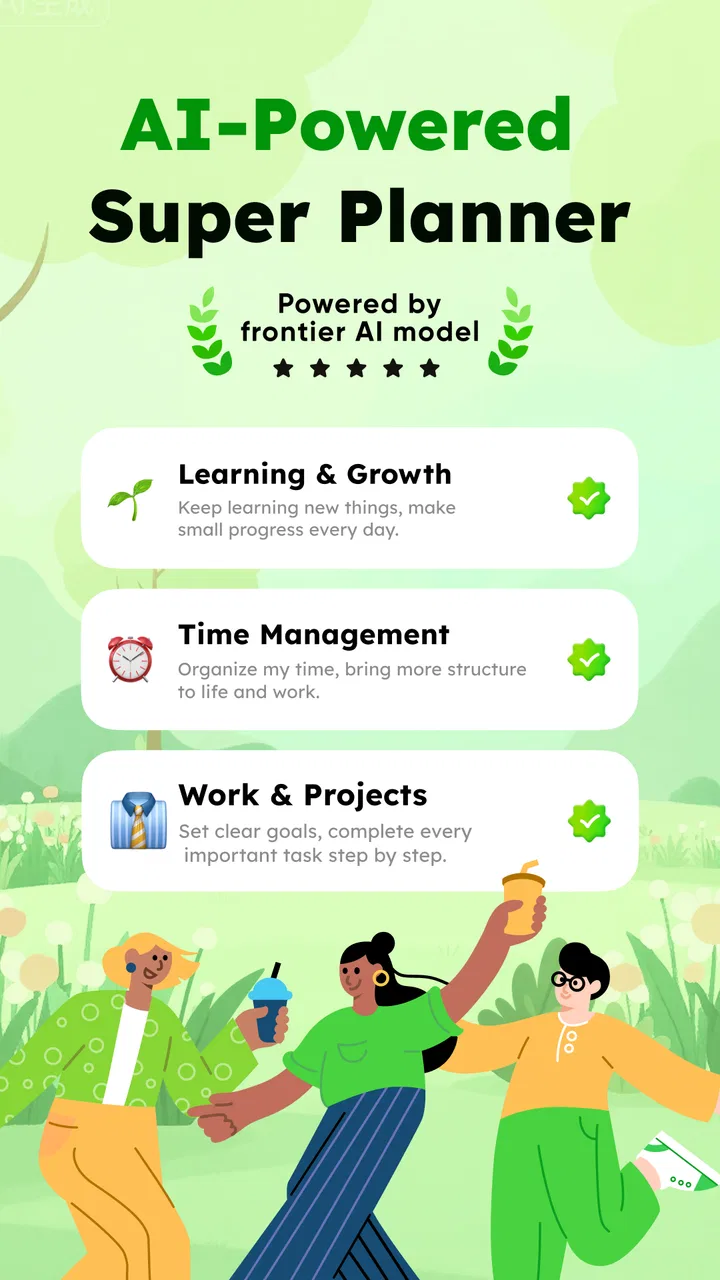
Super Planner: ADHD Routine AI
- 4.7
- Rating
- 100.00K
- Installs
- Free
- Price

 Analysis by App-foxy
I approached Super Planner: ADHD Routine AI as a practical productivity app rather than another list-making tool. Its promise is appealing: take a vague intention, turn it into manageable action, keep an eye on your mood, and make daily plans easier to follow. In my experience, that combination matters because the hardest part of productivity is often not knowing what to do, but starting when the task feels too large or your energy is unpredictable.
The app sits in the productivity category and is developed by Polestar App Cloner Dev. It is free to start, with optional in-app purchases ranging from $0.99 to $29.99 per item. The audience rating is Everyone, and the app runs on Android devices using version 8.0 or later. That makes it accessible for people using older phones, although the experience will naturally depend on the device and how comfortable you are with planning tools.
What interested me most was the complete workflow: beginning with an unfinished thought, shaping it into a plan, moving the plan into a real day, and then checking whether the result actually helped. That last step is important. A planner that only collects tasks can leave you with a prettier version of the same overwhelm. This app is more useful when you treat mood tracking and reflection as part of the planning process, not as separate decoration.
You May Also Like

 Blood Strike: 2.5 Anniversary
Blood Strike’s Loadouts Turn Every Drop Into a Tactical Gamble
A close look at Blood Strike’s custom loadouts: how fast access to signature weapons reshapes its battle royale rhythm, rewards preparation, and narrows the gap between fights.

 Pandora - Music & Podcasts
Pandora’s Music Is Easy to Start, but Harder to Recover
Pandora’s strength is its low-effort path from a seed to a station. Its weak spot is how much confidence it asks you to place in connection, setup, and quiet recovery.

 8 Ball Pool
 Is Built on Rivalries, Rematches, and Routine
A close look at the rivalries, rematches, shared routines, and unanswered safety questions that turn a quick pool match into a persistent mobile community.

 Samsung Music
’s Quiet Strength Is Playing What You Already Own
Its reach comes less from spectacle than from dependable access to a personal library. That simplicity is both the app’s strongest retention engine and its ceiling.

 AccuWeather: Weather Radar
AccuWeather Review: A Quick, Clear Forecast for Everyday Decisions
For everyday plans, the best forecast is the one you can understand quickly. AccuWeather makes rain timing, radar, and local conditions easy to act on, with a few trade-offs.

 Hill Climb Racing
Why Hill Climb Racing Still Turns Crashes Into One More Run
A tiny car, a bumpy hill and one more upgrade: Hill Climb Racing keeps resurfacing because its simple chaos makes every near-miss feel personal.
More From Our News Desk
View All News


From a vague goal to a workable day
I find the most useful way to judge a planner is to see what happens when an ordinary intention meets a crowded day. In this section, I look at how Super Planner can help turn a broad goal into a manageable next step, while keeping the plan flexible enough for real life. That practical starting point also makes it easier to consider what should—and should not—be shared when a device is used by more than one person.
Starting with the problem instead of the perfect plan
A realistic session does not begin with a beautifully organized list. It begins with something like, “I need to deal with my paperwork,” “I want to get back into exercise,” or “I have too many small things in my head.” The useful first move is to put that broad goal into the app and then break it into actions you can recognize and begin.
I found this approach more comfortable than opening a conventional calendar and immediately filling it with blocks. Calendars are excellent when you already know the exact appointment or deadline. They are less helpful when the issue is turning intention into a first step. Super Planner: ADHD Routine AI is better suited to that uncertain stage, where the task needs shaping before it deserves a place in your day.
For example, “organize the bedroom” is a poor action because it hides several decisions. A more usable sequence might involve choosing one surface, collecting items that belong elsewhere, and stopping after a defined amount of effort. The app’s goal-oriented design encourages this kind of translation. I would still do the thinking myself, because no planner can reliably understand the emotional weight, urgency, or physical difficulty of every task, but the structure gives that thinking somewhere to land.
The strongest habit is to enter the next visible action, not the entire ambition. If your goal is to prepare for a trip, begin with checking the dates or making a packing area rather than writing “prepare everything.” This reduces the handoff between planning and doing, which is where many productivity systems fail.
Building a plan that respects changing energy
The mood-tracking element gives the workflow a useful human adjustment. A plan that looks reasonable in the morning may become unrealistic after poor sleep, a stressful meeting, or a low-energy afternoon. Recording how you feel daily can help you notice that the same schedule does not work equally well every day.
I would use the mood check as a planning signal rather than a score to judge myself. On a difficult day, the right outcome may be completing one essential action and preparing the next one. On a better day, I might group several small tasks together. This is a more sustainable approach than treating every missed task as evidence that the whole system has failed.
There is also a practical trade-off here. Mood information is only useful if you record it consistently and honestly. If you skip it for long periods, the history becomes less helpful as a reflection tool. If you overanalyze every change, the tracking itself can become another obligation. I would keep entries quick and use them to adjust expectations, not to create a second productivity project.
Turning goals into actions without overloading the list
The central handoff is from a goal to a set of actions. This is where the app can feel more approachable than a basic notes application. Notes are flexible, but they leave all the organizing work to you. A conventional task list captures commitments well, yet it can become a long queue with no explanation of why a task matters. Super Planner connects the larger goal with the smaller movement needed to make progress.
My advice is to keep the first plan deliberately small. Add the actions that would create visible progress, then leave room for interruptions. A plan containing every possible step may look thorough, but it is harder to start and easier to abandon. The app works best when it helps you choose what matters today rather than preserving every possible future task.
This is also where the free entry point is useful. You can test the planning style before deciding whether the optional purchases are worthwhile for your routine. I would not pay simply because the app has an appealing concept; I would first see whether I return to it naturally and whether its planning process reduces friction compared with the tools already on my phone.
Moving from the app into real life
A plan only becomes useful when it leaves the screen. Imagine a weekday morning when I need to send two work messages, buy groceries, and make progress on a personal course. Instead of treating those as equal items, I would identify the smallest starting action for each, choose one priority, and use the mood check to decide whether the remaining tasks should stay ambitious or become lighter.
The handoff might look like this: I review the goal, select the first action, complete it away from the phone, and then return to mark progress or adjust the next step. That return matters because it closes the loop. Without it, the app is just a place where plans are stored. With it, the app becomes a record of what actually happened and a prompt for what should happen next.
I would also avoid constantly reopening the planner during a focused task. The app is most valuable at transition points: beginning the day, moving between responsibilities, and reviewing what remains. If you use it every few minutes to reorganize, planning can replace action. A short review before starting and a short review afterward are usually more useful than continuous rearranging.
Using routines without making them rigid
Routine support is particularly relevant for recurring responsibilities. A morning sequence, a study habit, household maintenance, or a wind-down routine can be easier to follow when it is externalized. The important distinction is between a routine that guides you and one that punishes you for variation.
I prefer treating a routine as a default route. If the day changes, I would preserve the most important step and postpone or simplify the rest. This prevents the common all-or-nothing reaction in which missing one item makes the entire routine feel ruined. The app’s value is not in producing a flawless streak; it is in helping you resume after disruption.
A useful tactic is to create separate expectations for normal days and low-capacity days. The normal version can contain the complete sequence, while the lighter version focuses on the action that keeps the habit alive. This makes the mood component actionable: it helps decide which version of the routine fits today instead of merely describing how today felt.
The result: progress you can actually interpret
The outcome I would look for is not a completely empty task list. That standard is too simplistic for real life. A better result is knowing what moved forward, what was postponed for a sensible reason, and what needs to be redesigned because it repeatedly fails to happen.
That distinction is one of the app’s more thoughtful possibilities. If a task remains unfinished, the answer may not be more motivation. It may be that the action is too broad, badly timed, emotionally uncomfortable, or dependent on another person. Reviewing the plan alongside your mood can reveal those patterns. For instance, if a certain type of task is always avoided late in the day, the solution may be to schedule it earlier or divide it into a less intimidating entry point.
This is where I see more value than in a simple checklist. A checklist tells you what remains. A goal-and-mood workflow can help you ask why it remains. That does not make the app a therapist, diagnosis tool, or substitute for professional support. It is simply a way to connect daily planning with personal observations.
Its public reception is encouraging, with a 4.7 average from around 6,400 ratings and over 100,000 installs. Those figures suggest that the idea is resonating with a meaningful audience, though they should not replace your own trial. Productivity tools are unusually personal: a feature that feels calming to one person can feel like extra administration to another.
Where the workflow breaks down
The first weak point is the amount of input required. If you are already overwhelmed, opening a planner, describing a goal, dividing it into actions, considering your mood, and reviewing the result can feel like work before the real work begins. The app reduces some of that friction, but it cannot remove the need to make choices. On an especially chaotic day, a single handwritten note or a basic reminder may be the better temporary option.
The second limitation is that planning quality still depends on task quality. If you enter broad, unclear goals, the resulting system can remain vague. The app may help you structure an intention, but it cannot know whether “deal with finances” means checking a balance, finding a document, making a call, or creating a budget. I would spend a little time defining the next physical action before expecting the workflow to feel effortless.
There is also a risk of overtracking. Mood entries can support self-awareness, but they should not become a daily performance review. If you notice yourself trying to produce the “right” mood pattern or feeling guilty about missed check-ins, simplify the process. The tool should serve your day, not become another source of pressure.
People who need shared project management, detailed team assignments, advanced calendar coordination, or deep note-taking may prefer a more specialized alternative. A standard calendar is still better for fixed appointments. A task manager may be better for complex dependencies and recurring work across several projects. A notes app remains faster for capturing unstructured ideas. Super Planner is most convincing in the space between those tools: personal goals that need breaking down, routines that need flexibility, and daily plans influenced by energy.
Who should try it, and who should skip it
I would recommend giving it a fair trial if you regularly know what you want but struggle to translate that intention into a first action. It is also a good fit if your productivity changes with mood or energy and you want a gentle way to notice that relationship. Students, people managing personal routines, and anyone rebuilding structure after a disrupted period may find the goal-to-action flow especially useful.
I would skip it if you already have a planning system that you use consistently and it solves the exact problem you have. Adding another app can create duplicate lists and split your attention. I would also look elsewhere if your main need is a shared workspace, a professional project board, or a calendar-first schedule. This is a personal productivity companion, not a universal replacement for every organizational tool.
The current release is version 1.5.60.0809, and the app was released on January 13, 2025. I mention that because the product feels like something worth evaluating through actual daily use rather than assuming it will fit from its description alone. Start with one recurring routine and one meaningful goal, keep the actions small, and see whether the review loop changes what you do.
My final take after following the full loop
Super Planner: ADHD Routine AI works best when I treat it as a bridge between intention and action. Its most useful contribution is not simply storing tasks; it is encouraging a sequence in which I define a goal, choose a manageable next move, account for my current state, and learn from the result. That makes it more personal than a static checklist without pretending to solve every productivity problem.
The app is free to begin, rated Everyone, and compatible with Android 8.0 or later, so trying the basic workflow is relatively straightforward. Optional purchases are available, and I would judge them only after the core habit proves valuable. If the planning steps feel lighter than the confusion they replace, this could become a dependable daily companion. If the process feels like another list to maintain, a simpler alternative will serve you better.
My honest recommendation is to use it with restraint. Do not plan your entire life on the first day. Give one goal a clear next action, record your mood without overthinking it, complete what you can, and review the handoff from plan to reality. That small experiment will tell you more than any feature list whether this productivity app belongs in your routine.
FAQs for Super Planner: ADHD Routine AI
01What is Super Planner: ADHD Routine AI, and who is it designed for?
Super Planner: ADHD Routine AI is a planning and routine-building app designed to help users organize tasks, appointments, habits, and daily priorities. Its features are particularly useful for people with ADHD who may struggle with time management, focus, or starting complex tasks. However, the app can also benefit students, professionals, parents, and anyone who wants a more structured daily routine.
02How does the AI help create routines and daily plans?
The app uses AI-based planning assistance to help turn goals, responsibilities, and tasks into a more manageable schedule. Instead of simply displaying a long to-do list, it can help break activities into smaller steps and arrange them into a practical routine. Results may depend on the information you provide, so reviewing and adjusting the suggested plan is important before relying on it.
03Can Super Planner: ADHD Routine AI replace professional ADHD treatment or advice?
No. Super Planner: ADHD Routine AI is a productivity and organization tool, not a medical treatment or diagnostic service. It may support routines, reminders, and planning, but it cannot replace an evaluation, medication guidance, therapy, coaching, or personalized advice from a qualified healthcare professional. Users with significant ADHD-related difficulties should continue working with their doctor or mental-health provider.
04Is Super Planner: ADHD Routine AI free to download and use?
The app may be available to download at no initial cost, but some features can require a subscription, in-app purchase, or premium plan. Pricing, trial periods, and included tools may vary depending on the platform, region, and current version. Before confirming a purchase, check the app-store listing carefully for renewal terms, cancellation instructions, and which planning features are restricted.
05What should I consider before entering personal information into the app?
Because the app is intended to create personalized routines, it may ask for information about your schedule, goals, habits, tasks, or daily challenges. Before using it extensively, review its privacy policy and the permissions requested on your device. Avoid entering highly sensitive medical, financial, or identifying information unless you understand how that data is stored, processed, shared, and deleted.
Pros
- AI-generated routines can adapt to changing schedules and daily priorities.
- Visual planning makes tasks easier to scan and follow at a glance.
- Helpful for breaking overwhelming goals into smaller
- manageable steps.
- Routine suggestions can reduce decision fatigue during busy days.
- Useful reminders may support consistency with habits and appointments.
Cons
- AI suggestions may feel generic without detailed personal customization.
- Some useful planning features may require a paid subscription.
- Notifications can become distracting if too many reminders are enabled.
- The app may not replace professional ADHD assessment or treatment.
- Routine setup can take time before the recommendations feel truly personal.

Super Planner: ADHD Routine AI
Gallery